Occupancy monitoring in 2026: Why the 15–30% Energy Gains Go to BMS-Integrated Buildings
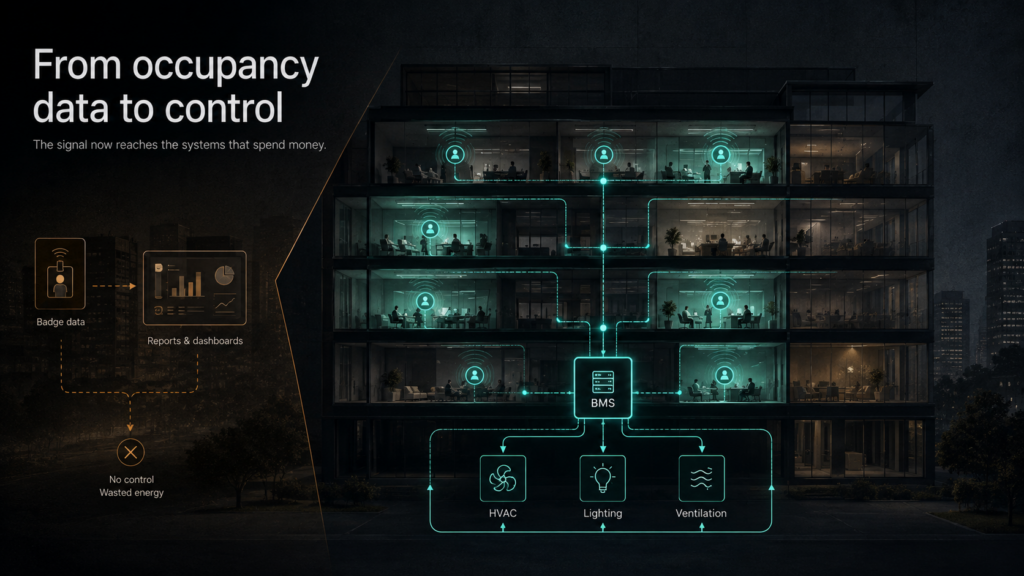
Occupancy monitoring in 2026 splits into two camps, and the 15–30% energy cost gap between them is now measurable rather than theoretical. Buildings syncing real-time occupancy with their BMS are pulling ahead on energy, cleaning and labour costs; buildings still exporting badge-swipe reports to a slide deck are not. The EU Energy Performance of Buildings Directive recast, which links ventilation control to real-time occupancy, has quietly moved the discussion from optional analytics to compliance infrastructure. The interesting question for next year isn’t whether to instrument, it’s whether the instrumentation terminates in a dashboard or a control loop.
Signal one: occupancy stops being a report and becomes a control input
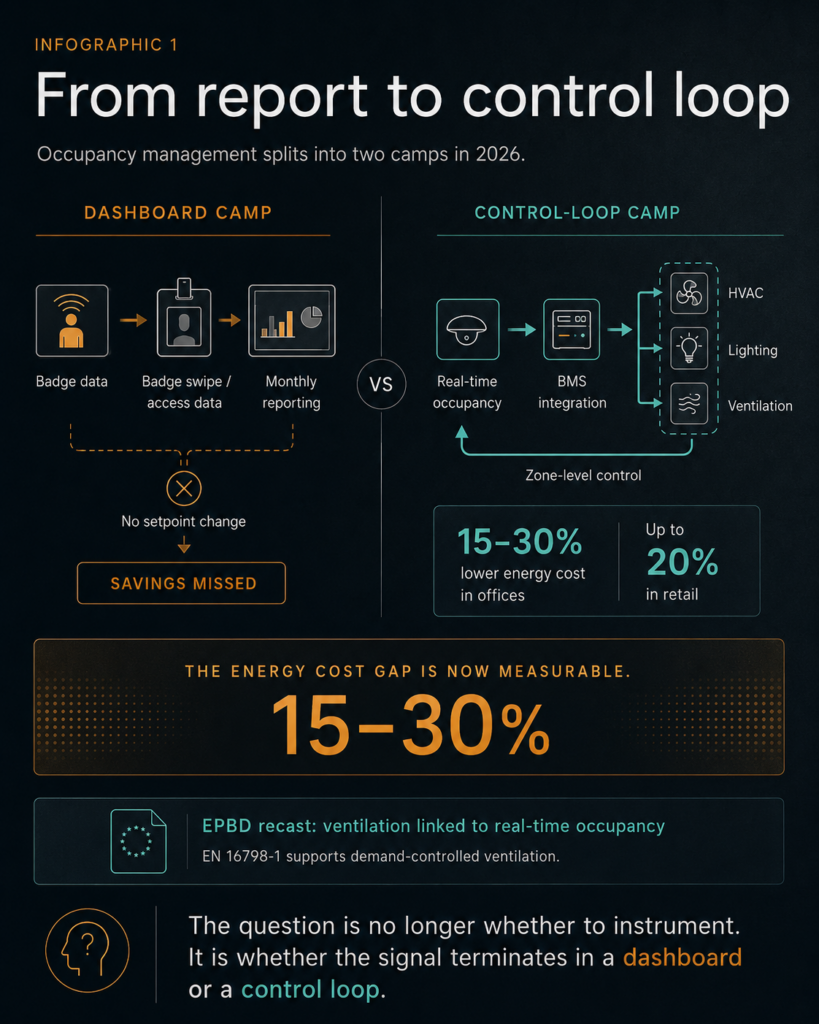
For roughly a decade, occupancy data lived in the CRE and workplace strategy stack: monthly utilisation decks, desk-booking heatmaps, the occasional consolidation business case. That’s changing because the plant is now the customer. Synchronising occupancy signals with HVAC, lighting and ventilation controls cuts energy costs by 15–30% across offices, and by up to 20% in retail environments according to the 2026 trend research now circulating through Verdantix and JLL work. Retail sees the lower end because trading hours already constrain plant schedules; offices see the upper end because hybrid patterns leave enormous conditioning waste in half-empty floors running on 2019 schedules.
The regulatory push matters more than the vendor push here. The EPBD recast explicitly ties ventilation rates to real-time occupancy in non-residential buildings, and EN 16798-1 already provides the demand-controlled ventilation framework operators are being asked to hit. That reframes the sensor conversation. It’s no longer ‘do we need better people-counting for the workplace team’ — it’s ‘can the mechanical services team prove ventilation is modulating against actual, not assumed, occupancy’. Those are two different budgets, and in 2026 they finally start converging.
Signal two: the sensor layer matures, the AI layer doesn’t and that’s fine
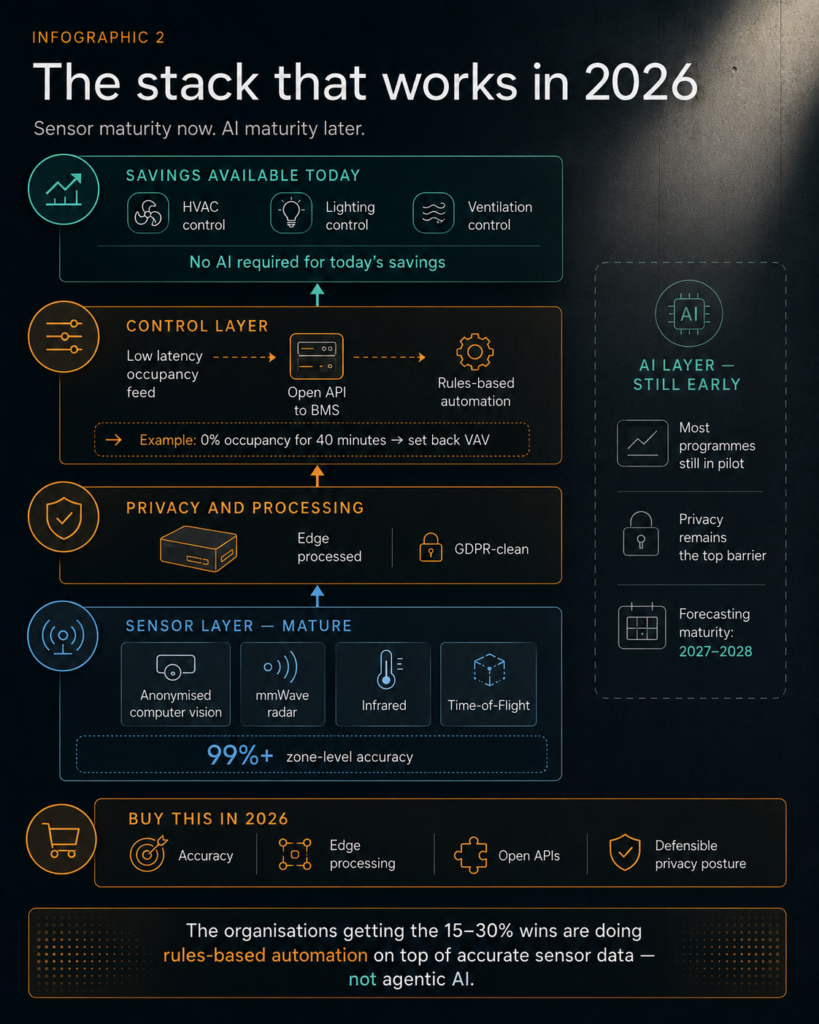
Most occupancy-AI programmes are still in pilot. Privacy concerns remain the top-cited barrier, and the honest reading of the enterprise landscape is that machine-learning forecasts of peak occupancy are a 2027-2028 conversation for most estates. Meanwhile the sensor layer has quietly become boring in the good sense: hybrid stacks combining anonymised computer vision, mmWave radar, infrared and Time-of-Flight now deliver zone-level accuracy above 99%, edge-processed, GDPR-clean.
This matters because rules-based BMS integration doesn’t need AI. It needs a reliable, low-latency occupancy feed and a control point that will accept it. A meeting room at 0% occupancy for 40 minutes doesn’t need a neural network to justify setting back the VAV box. The organisations getting the 15–30% wins in 2026 are almost universally doing rules-based automation on top of accurate sensor data — not agentic AI. The AI infrastructure being stood up now (Databricks, Fabric, the usual analytics substrate) is groundwork for 2027. The energy savings are available today, and mixed-use estates that have integrated environmental monitoring with occupancy insight have reported energy reductions of up to 30% without waiting for the AI story to mature.
The implication for procurement teams is unglamorous but important: don’t overpay for AI-branded occupancy platforms in 2026. Pay for accuracy, edge processing, open APIs to the BMS, and a defensible privacy posture. That’s the stack that delivers this year.
Signal three: hybrid work stabilises, and the CRE conversation shifts to data quality
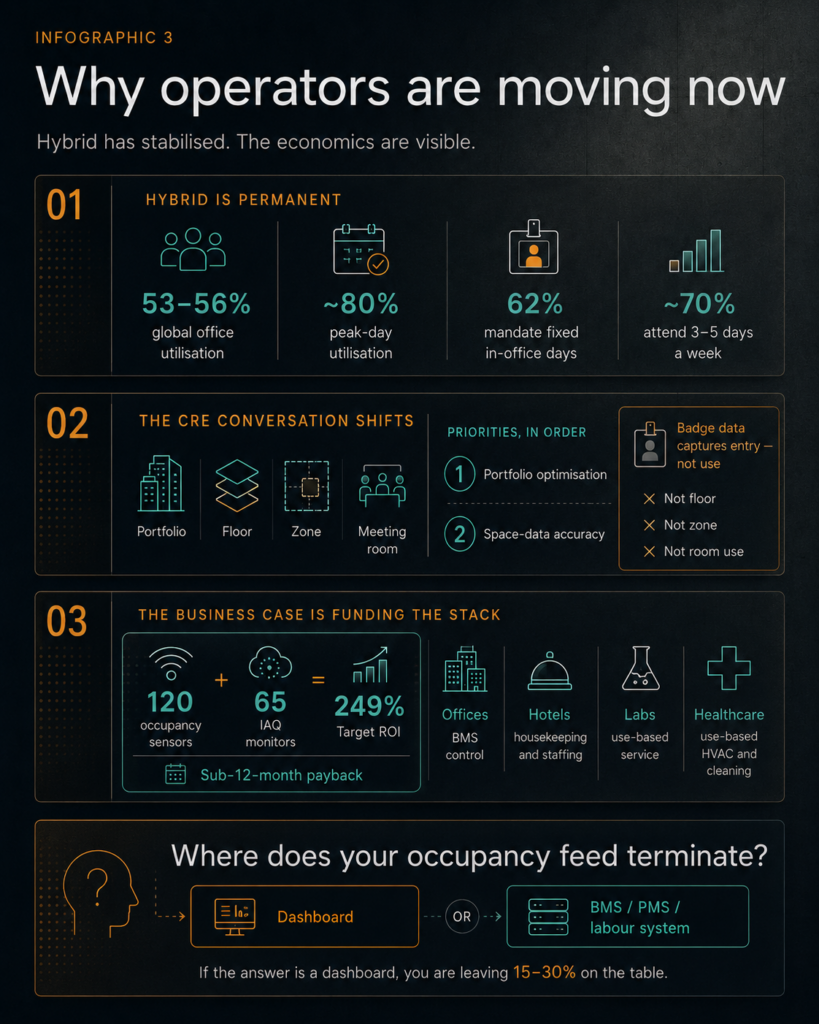
Global office utilisation has climbed to 53–56%, up from the low 30s during the remote-work trough, with peak-day utilisation hitting around 80% in the JLL and Leesman datasets. Roughly 62% of organisations now mandate fixed in-office days, about 70% of employees attend three to five days a week, and fully remote has receded to a minority pattern. The ‘is hybrid permanent’ debate is over. Hybrid is permanent, and it’s structured.
What’s interesting is what CRE leaders are now prioritising. Portfolio optimisation still ranks first at 71–80% depending on the survey, but improving space-data accuracy has moved to a solid number two — explicitly because leaders have realised the AI tools they’re being sold are only as good as the occupancy feed underneath. This is why ‘we already have badge data’ is failing as a defence in 2026 procurement conversations. Badge data captures entry, not use. It doesn’t know which floor, which zone, which meeting room, or whether the room booked for eight is being used by two.
One UK construction firm’s HQ programme illustrates the shape of the current business case: a deployment of 120 SpaceLens occupancy sensors and 65 indoor air quality monitors is targeting a 249% ROI with sub-12-month payback. Whether that specific figure lands is less important than what it signals about how the maths now works: with hybrid stabilised and utilisation rising, the underused capacity is legible, and the savings from right-sizing and BMS control are large enough to fund the instrumentation itself within a fiscal year.
Signal four: hospitality and specialised space quietly adopt the same playbook
Hotels are running a different version of the same shift. US occupancy is plateauing in the mid-60s%, and RevPAR growth is now ADR-led rather than occupancy-led according to STR and CBRE forecasts. That changes the operational maths. When you can’t grow the top line by filling more rooms, you defend the bottom line by aligning labour and housekeeping to actual pace, not last year’s calendar. Predictive housekeeping, dynamic room assignment and cross-trained flexible staffing are the 2026 operator moves, and they all depend on real-time occupancy telemetry flowing into the PMS and labour scheduling systems.
The same logic is now landing in labs, healthcare and other specialised spaces where fixed-schedule cleaning and HVAC are expensive and often unnecessary. Zone-level occupancy telemetry lets operators trigger service on actual use — a shift that read as futurology in 2022 and reads as sensible cost management in 2026.
What the synthesis actually asks of operators this quarter
The 2026 direction of travel is not ambiguous: Occupancy monitoring is becoming a control-layer input, not a reporting output. The organisations that will look prescient in 18 months are the ones treating occupancy data as plant-room infrastructure — interoperable, low-latency, privacy-defensible, and wired into the BMS, PMS or labour system that actually spends money.
The practical audit for this quarter is narrow. Where does your Occupancy monitoring feed terminate? If the answer is a dashboard, you’re leaving the 15–30% on the table. If the answer is a BMS setpoint or a housekeeping trigger, you’re already in the group that captures the 2026 gains. Platforms that treat occupancy alongside BMS and sub-meter feeds as queryable data — an approach visible in API-first tools that let sustainability leads interrogate the combined feed directly — suggest the architectural pattern most operators will converge on, whether they buy it or build it.
The story of Occupancy monitoring in 2026 isn’t a new sensor category or a breakthrough AI model. It’s the unglamorous plumbing question: does the occupancy signal reach the equipment that spends money? The regulations are pushing that way, the utilisation data justifies it, and the energy maths — 15–30%, this year, on rules-based logic — is now too large to defer. The buildings that treat this as a 2027 problem will spend 2026 subsidising the ones that didn’t.