From Research to Real-World: How DIREK Brought PREMIER to TRL 8
A 24-month journey in advanced wireless sensing, indoor tracking and next-generation network intelligence
After 24 months of research, engineering and close collaboration across the UK and Taiwan, the PREMIER projecthas officially reached its conclusion. The outcome is not just another research milestone. Together with our partners, we have delivered and validated a power-efficient Multi-Functional Reconfigurable Intelligent Surface, or MF-RIS, designed for the demands of emerging 5G and 6G network architectures. For DIREK, this project was especially significant because it allowed us to tackle one of the hardest technical challenges in the space: building a real-time mmWave and LiDAR tracking system that could work reliably in large, complex indoor environments and integrate directly into the MF-RIS framework. This was not a theoretical exercise. The system was deployed, tested and validated in a live setting, moving the project to TRL 8 and demonstrating clear commercial relevance for smart buildings, high-density indoor environments, and future wireless sensing applications.Why PREMIER mattered
Reconfigurable Intelligent Surfaces have been discussed for years as a promising enabler for next-generation wireless networks. In theory, they can improve signal propagation, reduce dead zones, enhance spectral efficiency and support more intelligent network behaviour. But theory alone is not enough. The challenge has always been turning that promise into something practical, scalable and power-efficient enough for real-world deployment. That is exactly what PREMIER set out to do. The ambition was to engineer an MF-RIS platform that could move beyond lab demonstrations and become a realistic building block for future wireless infrastructure. That meant tackling not just RF performance, but also environmental awareness, sensing quality and system-level integration. This is where DIREK’s contribution became critical.DIREK’s role: building the sensing and tracking intelligence layer
A major part of PREMIER’s success came from DIREK’s development of a real-time mmWave and LiDAR environment tracking system, integrated directly into the wider MF-RIS framework. Our role was to help give the system spatial awareness. In practical terms, that meant enabling the platform to understand what was happening inside a live indoor environment, where people were, how they were moving, and how that information could be captured accurately across a distributed sensing network. This was one of the most technically demanding workstreams in the project, because real indoor environments are noisy, reflective, dynamic and difficult to interpret reliably in real time. To make the system viable, the DIREK team focused on solving four core challenges.-
Human-object discrimination
-
Posture and activity tracking
-
IR reflection mitigation
-
Real-time multi-sensorsynchronisation
Built for scale, not just demonstration
One of the strongest aspects of the integrated solution was its ability to perform at scale. The system was successfully deployed and stress-tested across a continuous 2,000+ sqm area, monitored simultaneously through a networked array of LiDAR sensors. This is important because many sensing systems show promise in tightly controlled or limited spaces but struggle when expanded to larger, more realistic deployments. By validating performance across a significantly larger footprint, the project demonstrated that the approach is not only technically credible but operationally relevant. For DIREK, this scalability matters because it aligns directly with how advanced sensing and positioning systems will need to function in the real world, across commercial buildings, workplaces, public spaces and other high-density indoor environments.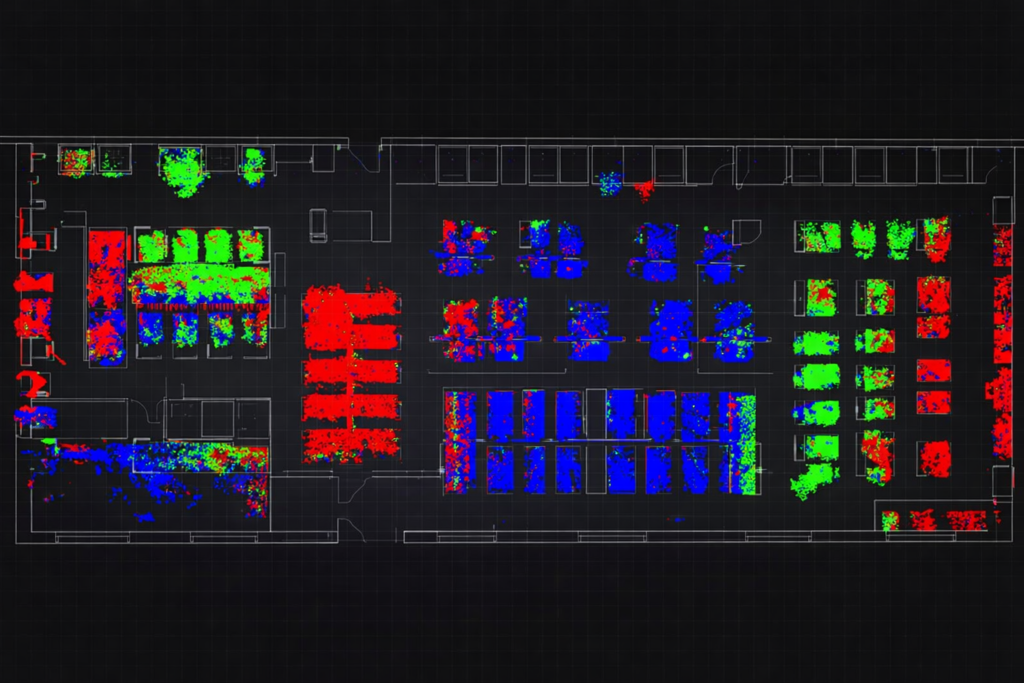
Live validation at YTTEK’s facility in Taiwan
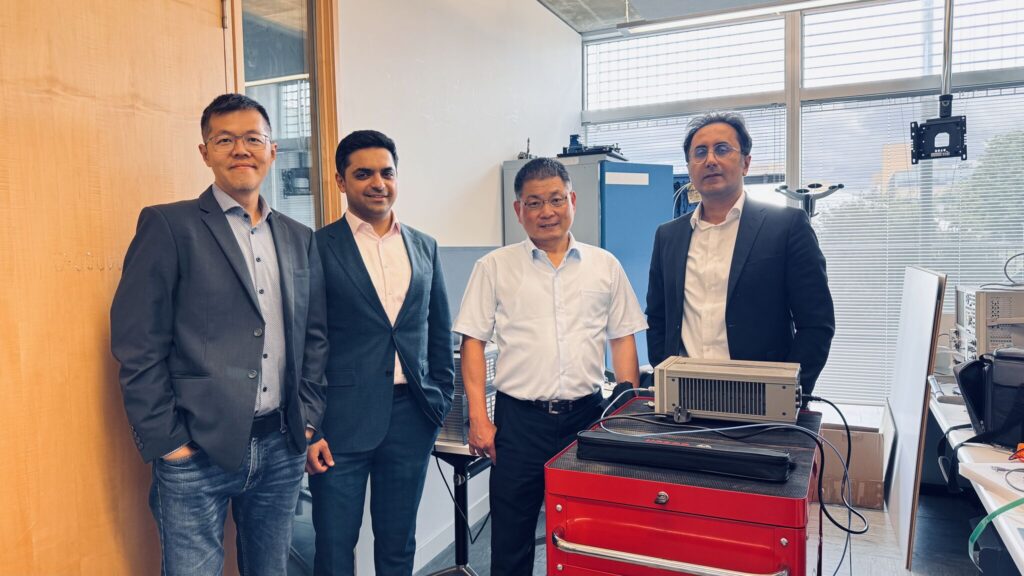
The full system was validated during an on-site deployment at YTTEK’s new office in Taiwan. This stage was particularly important because it moved the work beyond the controlled conditions of the lab and into a real operating environment. Live validation in a functioning indoor setting is where assumptions are tested properly. Reflective materials, changing human movement, sensor alignment complexity and environmental variability all become real engineering constraints rather than theoretical considerations. The deployment confirmed that the integrated system could operate successfully in a practical setting, and it played a key role in bringing the project to TRL 8, indicating readiness for commercial deployment. That is a meaningful milestone, not just for the consortium, but for the broader market opportunity around smart buildings, indoor positioning and intelligent wireless sensing.Why this matters commercially
The relevance of this work goes beyond research. As buildings become more connected, and as next-generation wireless infrastructure becomes more adaptive and context-aware, the value of accurate real-time indoor tracking will only grow. Systems that can combine wireless intelligence, environmental awareness and scalable sensing will be central to the next wave of smart infrastructure. The capabilities developed through PREMIER have clear relevance for applications such as:- Smart buildings
- Indoor positioning and location tracking
- Workplace analytics
- Human activity recognition
- High-density office and commercial environments
- Future wireless sensing and network optimisation