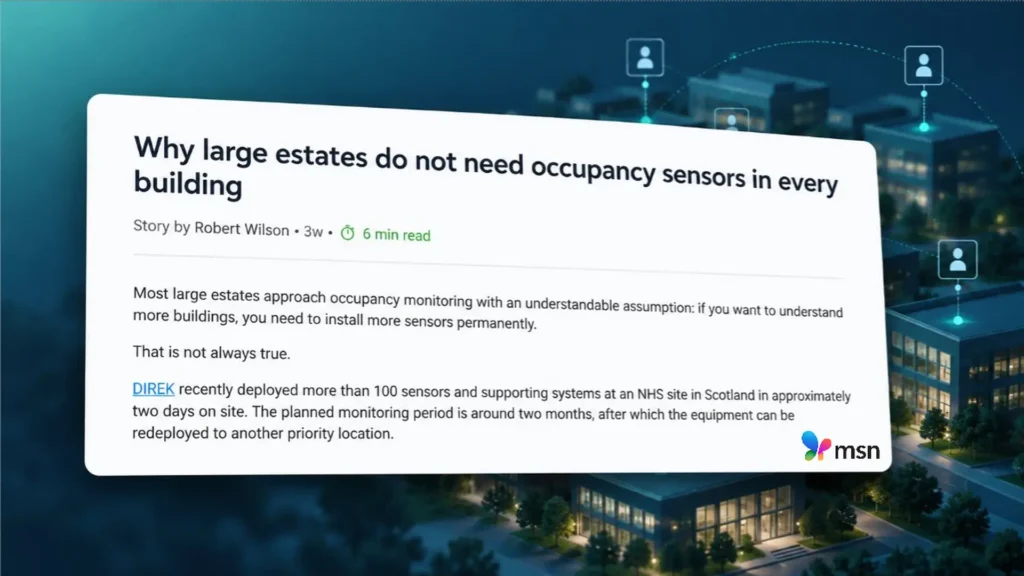
DIREK Shares Its Large-Estate Occupancy Monitoring Approach on MSN
DIREK has shared its latest perspective on occupancy monitoring for large and complex estates, now available to read on MSN.
The article, “Why Large Estates Do Not Need Occupancy Sensors in Every Building,” challenges the assumption that organisations must permanently install sensors across every property to obtain reliable estate-wide insights.
For many estates and facilities teams, the immediate objective is to answer a defined question: which spaces are underused, where operational resources should be prioritised, or whether a building requires further investment. In these situations, temporary occupancy monitoring can provide the evidence required without the cost and complexity of a permanent estate-wide installation.
DIREK’s approach allows occupancy sensors and supporting systems to be deployed for a defined monitoring period. Once sufficient data has been collected, the equipment can be redeployed to another priority location. This gives organisations the flexibility to investigate multiple buildings progressively while maintaining access to reliable occupancy and space-utilisation data.
The article includes a recent DIREK deployment involving more than 100 sensors at an NHS site in Scotland. The system was installed in approximately two days on site and planned around a defined monitoring period, after which the equipment could be moved to another location.
For large estates, the key principle is straightforward: use temporary monitoring where the question is temporary, and continuous monitoring where ongoing operational decisions depend on live occupancy data.
Learn how DIREK helps organisations turn reliable occupancy data into evidence-based estate decisions through our space optimisation and occupancy management solution.