Which Building Sensors Do You Need, and for How Long?
Every sensor proposal answers the same question: how many. Very few answer the harder one: for how long. That second question is where most of the budget is won or lost. Buy permanent hardware to settle a temporary question and you will keep paying for it years after the decision was made, long after anyone last opened the dashboard.
This guide covers five things: which sensors a building genuinely needs, how long each type needs to stay in place, when to choose portable over hardwired, what actually drives sensor cost, and whether leasing solves the problem or simply moves it into a different column of the budget.
Start with the decision, not the device
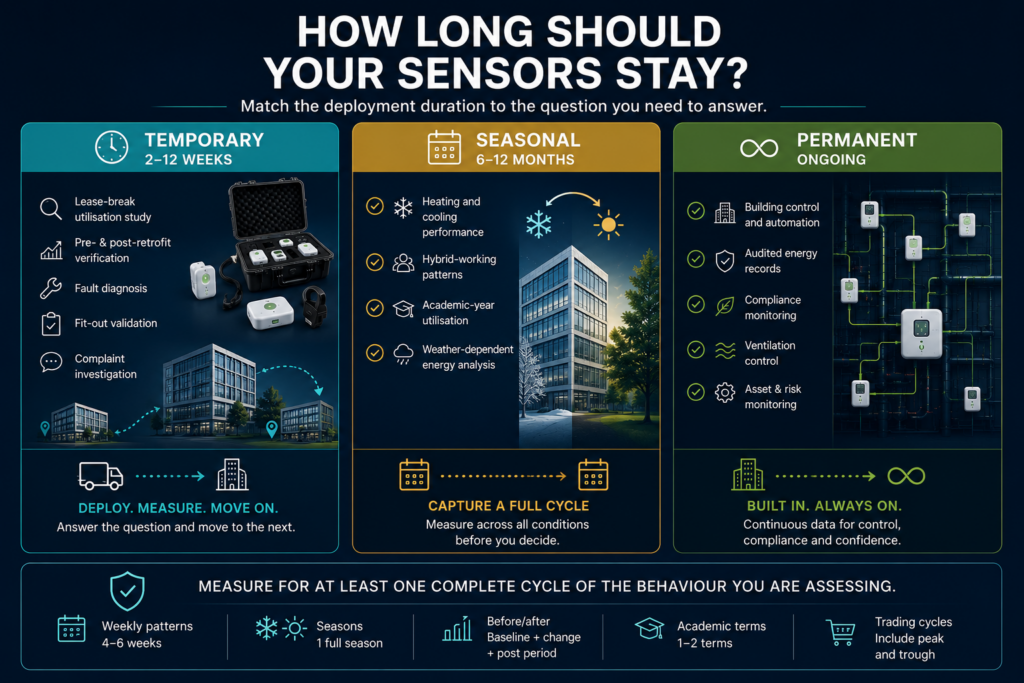
Sensor catalogues are organised by technology. Buildings are not. A better starting point is the job you need done, then the minimum sensing that supports it.
| Job to be done | Typical sensing | What it answers |
|---|---|---|
| Space and people | mmWave radar, LiDAR, PIR, thermal, camera | Utilisation, right-sizing, lease decisions, cleaning on demand, meeting room efficiency |
| Environment and comfort | CO2, temperature, humidity, VOC, particulates, noise | Ventilation strategy, complaint resolution, wellbeing, WELL and Fitwel evidence |
| Energy and plant | CT clamps, sub-metering, flow and return temperatures, run hours | Out-of-hours waste, HVAC faults, measurement and verification |
| Asset and risk | Leak detection, door contacts, filter differential pressure, temperature probes | Compliance, failure prevention, insurance evidence |
| Amenity demand | Washroom analytics, catering demand, consumables | Service levels matched to real demand rather than assumed demand |
Most over-specification happens because someone buys the catalogue rather than the question. If you cannot name the decision a sensor will inform and the person who will make it, you do not need that sensor yet.
Choosing the sensing method matters as much as the count
Within occupancy alone, the technology you pick changes the answer you get and the approval process you face.
- PIR is cheap but only detects motion, so a still meeting reads as an empty room. Fine for lighting control, poor for utilisation evidence.
- Camera-based systems are accurate but process images, which attracts privacy and procurement scrutiny in the UK and Europe that can add months to a project.
- Wi-Fi and badge data are already in the building but measure devices and doors, not people and space.
- mmWave radar detects presence and movement without capturing images, and works through some materials and in any lighting condition. This is what the DIREK-M sensor uses: 60GHz radar, ceiling-mounted, up to 28 square metres per unit across a 120 degree field, anonymised at source.
- LiDAR gives finer spatial resolution for counting and flow in complex or high-traffic areas. This is the basis of D-TECTOR, our LiDAR sensing line, used where precise counting matters more than simple presence.
The practical point: match the method to the question. Presence in a meeting room is a different problem from counting people through an atrium, and buying one technology for both is how projects end up with data nobody trusts.
How long do you actually need them?
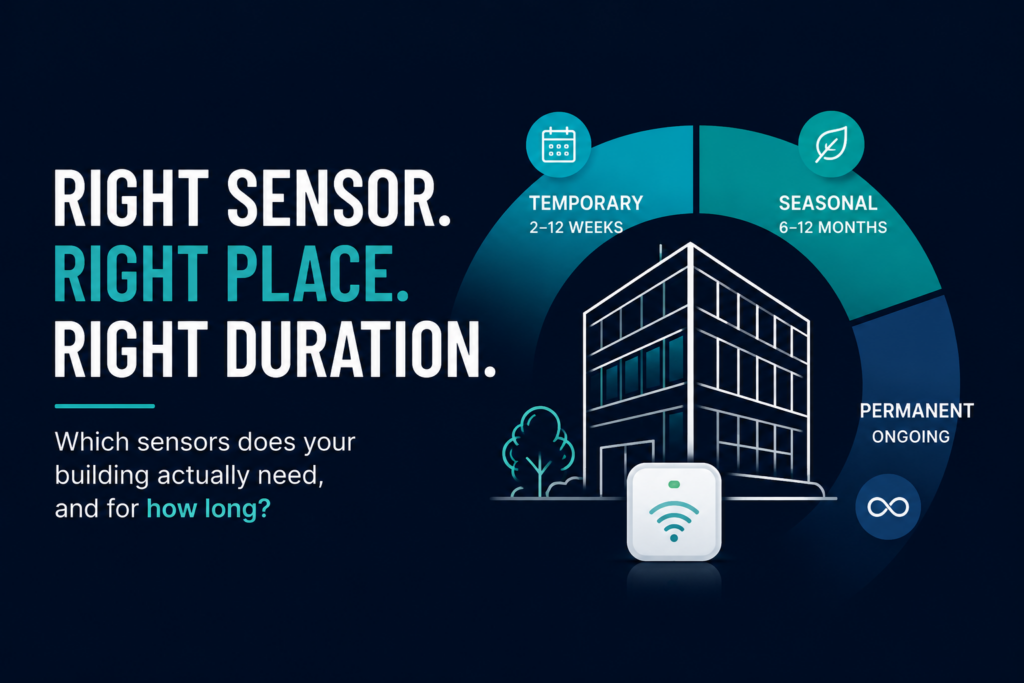
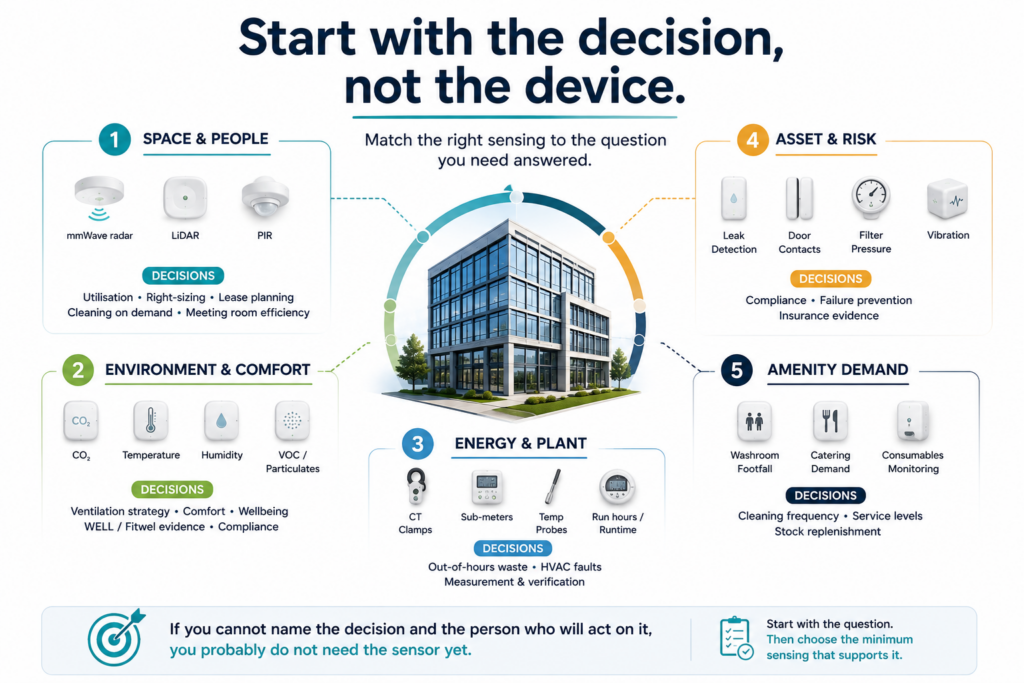
Sensing needs fall into three tiers, and confusing them is expensive.
Permanent
Anything feeding a control loop or an audited report stays in place indefinitely. Energy meters. Compliance temperature monitoring. Indoor air quality where it drives ventilation rather than just informing a report. If the data has to be reproducible for an auditor in three years, it is permanent. This tier underpins ESG reporting, where a gap in the record is a gap in the evidence.
Seasonal, six to twelve months
Plant performance needs a full heating and cooling season before you can judge it. Occupancy needs a full policy cycle if hybrid working patterns are still settling, and a full academic year in education estates. Anything weather-dependent belongs here.
Temporary, two to twelve weeks
Utilisation studies ahead of a lease break. Pre and post retrofit verification. Fault diagnosis. Fit-out validation. Complaint investigation. Business case evidence for a workplace change. These are finite questions with finite answers.
A rule for sizing the window
Measure for at least one full cycle of the behaviour you are deciding on, and never let the window sit entirely inside an atypical period.
- Weekly working patterns: four to six weeks minimum, avoiding school holidays and August
- Seasonal plant behaviour: one full heating season and one full cooling season
- Verification of a change: a baseline period, the intervention period, and a comparable post period
- Academic timetabling: at least one full term, ideally two, because week one never looks like week eight
- Retail and hospitality: a full trading cycle including at least one peak and one trough
Here is the trap. A large share of sensor spend in commercial estates is permanent hardware installed to answer a temporary question. The device outlives the decision by years. Nobody looks at the output after month four. The asset stays on the balance sheet, the licence keeps renewing, and the next study gets refused because the last one is still being paid for.
Portable or hardwired? Match the fixing to the timeframe
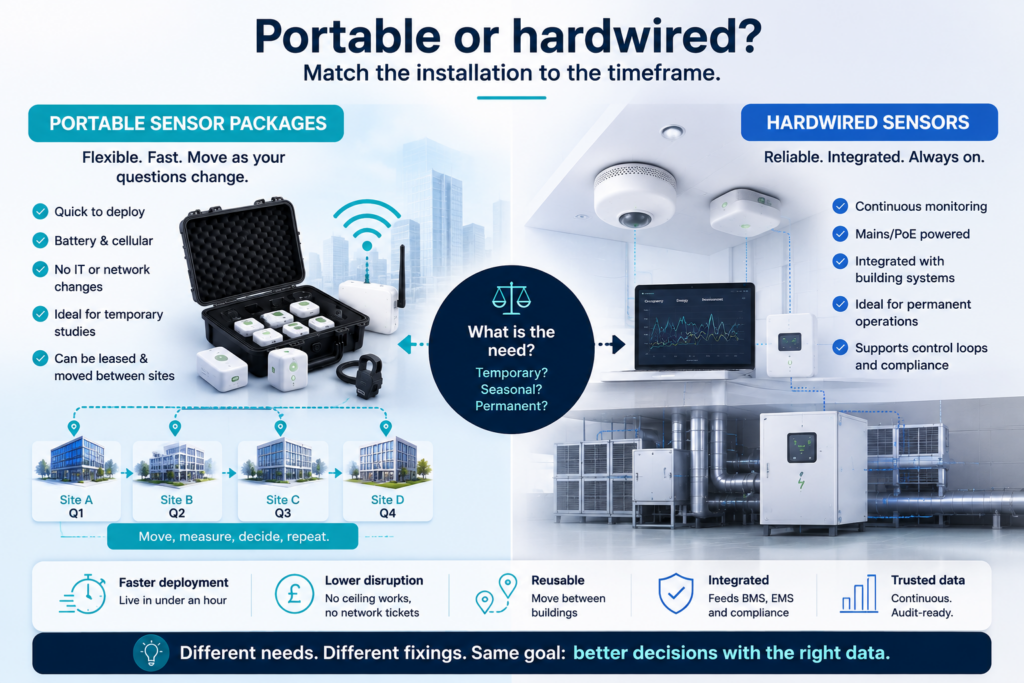
This is the decision most estates skip, and it is the one that determines cost. The two options are not competing products. They serve different tiers.
| Hardwired and fixed | Portable kit | |
|---|---|---|
| Power | Mains or PoE | Battery |
| Connectivity | Building network, IT involvement | Built-in cellular SIM, no Wi-Fi, no IT ticket |
| Install | Contractor, access equipment, containment | Plug and play, live in under an hour |
| Best for | Permanent, audited, control-linked sensing | Studies, verification, pilots, portfolio decisions |
| End of use | Decommission and make good | Pack up and redeploy |
DIREK offers both, deliberately. Where sensing has to live in a building permanently and drive control, hardwired is the right answer. Where you are answering a question, our portable sensor packages are battery powered and SIM connected, so there is no wiring, no Wi-Fi and no IT approval queue. A kit ships in a box and is live in under an hour.
What actually drives sensor cost
The unit price on the quote is rarely the biggest number. The full stack usually looks like this:
- Hardware. The visible cost, and often the smallest line
- Installation. Access equipment, out-of-hours working, ceiling work, containment, making good
- Connectivity. Gateways, network provisioning, IT security review, sometimes a separate VLAN
- Software licence. Frequently charged per sensor per year, which is the line that compounds
- Maintenance. Batteries, calibration, firmware, replacements, and the FM time to chase all of it
- Decommissioning. Removal and reinstatement at end of term or end of lease, which almost never appears in the original quote
Two conclusions follow. First, anything that removes installation and removal effort has an outsized effect on total cost, which is why cellular and battery power matter more than they sound. Second, a per-sensor annual licence on a permanent deployment will, given enough years, dwarf the hardware. Ask for the ten-year figure, not the year-one figure.
Does sensor leasing solve the cost problem?
Partly. It is worth being precise about which part.
What leasing genuinely fixes
- Capital expenditure becomes operating expenditure, so the project clears the approval threshold that quietly kills most pilots
- No depreciation on hardware in a category that dates quickly
- Calibration, firmware and replacement stay with the supplier rather than landing on your FM team
- A twelve-week study becomes a twelve-week cost rather than a ten-year asset
- Obsolescence risk sits with the party best placed to manage it
What leasing does not fix
- If the hardware is fixed and site-specific, you are still paying for coverage you no longer need. Financing a stranded asset leaves you with a stranded asset
- Per-sensor licence fees over a long term can still exceed the hardware cost
- Minimum terms and early exit fees can remove the flexibility you were buying
- Decommissioning is still someone’s cost, so check whose
The four models compared
| Buy and fix | Buy portable | Lease and fix | Lease and rotate | |
|---|---|---|---|---|
| Budget treatment | Capital | Capital | Operating | Operating |
| Approval friction | High | Medium | Low | Low |
| Obsolescence risk | You | You | Supplier | Supplier |
| Cost once the question is answered | Continues | Redeployable | Runs to end of term | Moves to the next question |
| Devices needed across a portfolio | Highest | Low | Highest | Lowest |
| Best suited to | Permanent, control-linked sensing | Repeat internal studies | Long-running single-site monitoring | Multi-site portfolios under review |
The honest conclusion is that leasing changes who carries the risk. On its own it does not change how much sensing you have to buy. The cost problem is not really a price problem. It is a utilisation problem, and the fix is portability.
The quarterly rotation model
Nobody buys a scaffold for every building they own. They hire it, use it, take it down and move it. Temporary sensing works the same way, and this is exactly how several of our larger portfolio clients operate.
They lease a pool of portable kits rather than buying permanent installs. Each kit lands in a building at the start of a quarter, runs long enough to produce a defensible answer, and moves on at the end of it. Over a year, one kit covers four buildings.
The arithmetic is simple. A sixteen-office portfolio instrumented permanently needs sixteen deployments. The same portfolio surveyed on a quarterly rotation needs four kits to cover every site inside twelve months. Same evidence base, a quarter of the hardware, and the spend converts to a predictable operating line rather than sixteen separate capital approvals.
Two conditions make it work. The hardware has to be genuinely quick to deploy and recover, which is why battery and cellular matter. And the platform has to retain the history after the sensors leave, otherwise you lose the estate-wide comparison that made the exercise worth doing. D-XPERT holds the record permanently while the hardware moves, with SpaceLens presenting the space view across every site you have surveyed. Because it is open and API-first, it also reads your existing BMS, EMS and MQTT devices alongside ours, so the rotating kits fill the gaps rather than duplicating what is already installed.
What is actually in a portable package
Our portable sensor packages come as five ready-built kits, each aimed at a different question:
- ESG and Energy Sentinel for BREEAM and NABERS evidence and out-of-hours waste. Six current energy clamps, two room occupancy sensors and an LTE gateway, at £1,845
- Agile Workspace Optimiser for desk and room utilisation in hybrid estates
- Well-being and Productivity Hub for indoor air quality, comfort and WELL v2 alignment
- Essential Workplace Monitor as a starting point for room occupancy and AI reporting
- Compliance Kickstart for Fitwel v3 and baseline compliance evidence
Every package includes twelve months of D-XPERT across SpaceLens, EnergyLens and EnvironmentLens, three expert performance reports, and a dedicated account manager. Platform access continues at £395 per year afterwards. There is a thirty day money-back guarantee, UK delivery is typically three days, and volume pricing applies to bulk orders. If none of the five fits, you can build a custom package.
What this looks like in practice
A London HQ facing a 2027 lease break needed to know whether the building was genuinely full or just heavily booked. That is a finite question, and the answer was worth millions. A multi-site organisation running three buildings on three different property systems needed one view to decide which offices to keep. A Manchester site with two divisions and no visibility of either used measurement to drive an office footprint reduction. If reducing property cost is the goal, our save space use case sets out the approach.
The same logic applies outside offices. A secondary school could not tell how much of its bill was an empty building running in the dark, which is the classic energy saving case. A university with around 300 desks and seven rooms had no hourly evidence of demand until it measured. An Irish college used measurement across six rooms to align timetables with actual attendance. An engineering consultancy tackled fixed HVAC schedules and space visibility together at its Farnborough office.
None of those required permanent estate-wide instrumentation. They required the right sensing, in the right place, for long enough to answer the question. The full set is on our case studies page.
Ten questions to ask any sensor supplier
- What decision will this data support, and who signs it off?
- What is the minimum deployment period that produces a defensible answer?
- What is the total cost over ten years, not year one?
- Is the software licence charged per sensor, per site, or per estate?
- Does the kit need Wi-Fi, mains power or an IT security review?
- What happens to the hardware when the study ends?
- Who pays for removal and making good?
- Can the hardware be redeployed to another building, and at what cost?
- Can the platform ingest sensors we already own, or does it only read yours?
- If we leave, what happens to the historical data?
Question nine separates a platform from a lock-in. Question ten separates a partner from a supplier.
Frequently asked questions
How many sensors does a building need?
It depends on whether you are answering a question or running a control loop. Control needs coverage. Questions can often be answered by instrumenting representative zones and extrapolating across comparable space types, which usually needs far fewer devices.
How long should an occupancy study run?
Four to six weeks is the practical minimum for weekly working patterns, and it should avoid holiday periods. Education estates should plan for at least a full term.
Is leasing cheaper than buying sensors?
Over a short deployment, usually yes, because you pay only for the period you need and avoid capital approval. Over a long permanent deployment the comparison narrows, so ask for the full-term figure before deciding. Leasing pays for itself fastest when the hardware moves between sites rather than sitting in one.
Do occupancy sensors capture personal data?
It depends entirely on the technology. Camera-based systems process images. DIREK-M anonymises at source and captures no images, which is why it clears privacy review more easily.
Can we move sensors between buildings ourselves?
With portable kits, yes. They are battery powered and SIM connected, so relocating a kit does not need a contractor or an IT change request. Larger clients typically rotate kits across their portfolio on a quarterly cycle.
Can we keep the sensors we already have?
Yes. D-XPERT is open and API-first and works with existing BMS, EMS and MQTT devices, so adding a decision layer does not mean replacing what is already installed.
Where to start
Pick your single most expensive open question. Size the sensing to that question rather than to the building. Set an end date before you set a budget. Then decide whether that sensing needs to be owned, or simply available for as long as the question is open.
To talk through a portable deployment or a rotating lease across your portfolio, book a free consultation. Higher education teams should look at our HE offers, and integrators or resellers should see our partnership page.