AI can write a building energy report in minutes. A senior energy specialist may spend hours checking it. Budget for that work when adopting AI in facilities management.
In McKinsey’s 2026 survey, 80% of respondents said AI improved their individual productivity, while 37% reported a positive contribution to enterprise earnings before interest and tax. These are different, self-reported measures.[1] For facilities teams, faster tasks still need to translate into savings that reach the bill or decisions the team can act on.
The choice is whether to build an in-house service around general-purpose tools such as ChatGPT or Claude, or use an expert solution. Both can use large language models (LLMs). The difference is who builds and maintains the analysis, integrations and checks that turn output into decisions.
Making AI in facilities management useful
Competitor announcements and endless AI roundtables can make adoption feel urgent. Start with the decision that needs to improve. Reducing unnecessary site visits, prioritising maintenance and identifying energy waste require different evidence and workflows. Name the owner and the result you will measure before choosing a model.
When checking the numbers becomes the job
“Our current reporting platform is inefficient” and “manual spreadsheets updated monthly” describe a familiar starting point. Energy reporting software can increase output while leaving the work of reconciling data and checking numbers untouched.
Workday’s 2026 report, covering 3,200 AI users, estimated that nearly 40% of AI time savings were lost to correcting, rewriting and checking output.[2]
An analyst may save time drafting while a more expensive specialist spends longer checking calculations and correcting recommendations. If that rework absorbs the saving at equivalent quality, the technology has shifted the workload without improving productivity.
A request for “executive summaries, ideally two pages” makes the point: people need enough evidence to decide, with a manageable review burden. Building repeatable checks also costs money. Budget for reference calculations, representative tests and expert review alongside the API. A cheap API does not make the complete service cheap.
Why promising pilots stall
An AI proof of concept (PoC) demonstrates that an idea can work in selected conditions. A minimum viable product (MVP) tests an initial offering. Neither automatically establishes that the service can operate reliably and economically across a portfolio.
The difficult work often sits outside the demo: maintaining integrations, handling missing data, investigating disputed recommendations and deciding who owns the findings after the report. Changes to models, tariffs or operating conditions can make earlier recommendations unsuitable for current decisions.
NIST’s voluntary AI Risk Management Framework recommends realistic test sets representing expected use, with ongoing testing or monitoring after deployment. A convincing demonstration does not establish dependable performance across different buildings.[3]
Why buildings expose the gaps
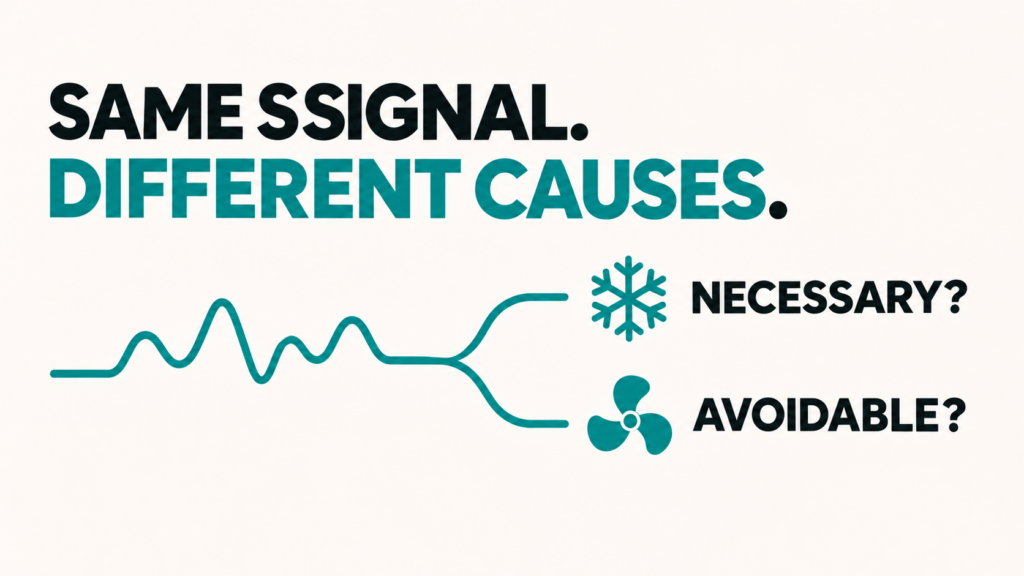
AI energy management must distinguish a pattern from its cause. Out-of-hours energy use might reflect avoidable operation, refrigeration, frost protection or necessary preheating. Plant can follow its schedule perfectly while serving an empty floor, contributing to the performance gap between intended efficiency and actual use.
Metering problems affect data accuracy. Energy data quality also depends on interpretation: kW measures power and kWh measures energy; missing readings must not become zero consumption; main meters and submeters must not be double-counted. Incorrect timestamps can make legitimate use appear out of hours.
JLL’s 2026 facilities management research identifies data readiness as the weakest starting foundation for AI adoption.[4] In post-occupancy evaluation, these checks help building owners and contractors distinguish poor energy performance from faulty measurements or missing operating context.
Agentic workflows raise the stakes
Agentic AI extends beyond generating reports. Systems use language models to plan tasks, call tools and execute workflows, sometimes coordinating several agents. An output can become an input to the next decision or action, allowing errors to propagate.[5]
Consider a hypothetical building workflow. One agent mistakes missing occupancy data for an empty floor. Another estimates savings from reducing heating. A third, if authorised to change controls, applies a new schedule. The error has travelled into a physical change. Agreement between agents provides little reassurance when they share the same faulty premise.
Check intermediate decisions, tool inputs and consequences. Enforce permissions outside the model and define when to stop, request evidence or seek approval. Systems able to alter building operation also need monitoring and a practical way to reverse or override inappropriate changes.
Measure value after the whole job is finished
McKinsey’s respondents reporting the strongest enterprise gains were also more likely to have redesigned workflows around AI.[1] Define what the team will stop doing, which checks remain and who owns exceptions.
Buyers need reports to justify the investment. Measure data preparation, analysis, checking, corrections and approval at equivalent scope, quality and coverage. Include fully loaded staff costs, integration, technical support and ongoing testing. Track cost per accepted report and review hours, then whether recommendations are implemented and savings reach the bill.
“Try it on our own data first” is a sensible starting point. A three- or four-room trial can test data access, usability and review effort. Agree acceptance criteria and keep some test cases separate from development. Compare with the current process, then evaluate different buildings, seasons and difficult data conditions before expanding.
Make explainable AI practical: keep source data, calculations and assumptions beside each recommendation, with method and model versions recorded. Re-test when models, analytical methods or tariffs change. Anthropic’s agent-evaluation guidance stresses regression testing and human calibration of automated judges.[5] A second model’s agreement, on its own, cannot establish technical correctness.
The decision to build or buy
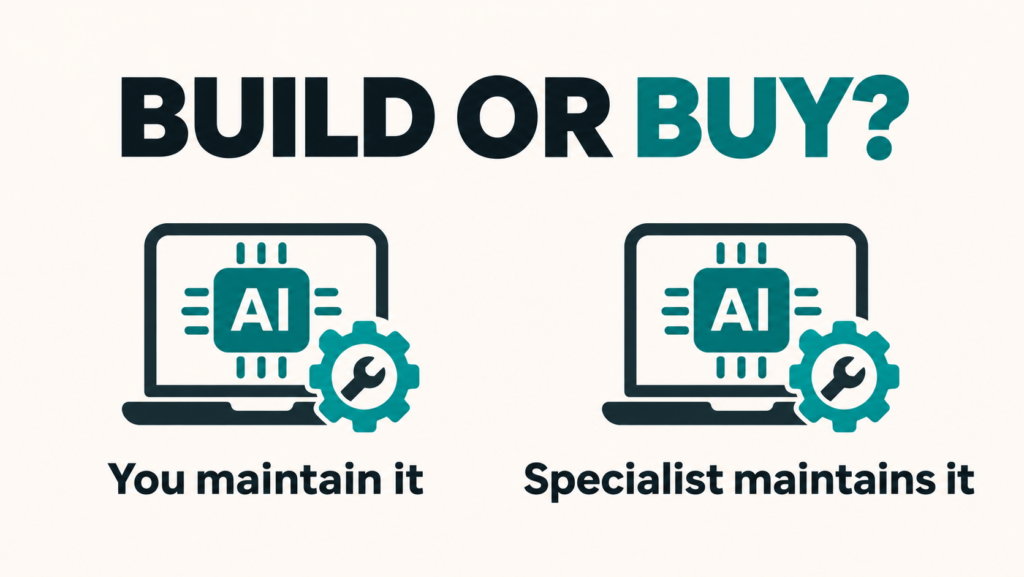
Build in-house when the capability is strategically distinctive and you can fund the domain expertise, integrations, testing, security and continuing support. Consider an expert solution where reusable methods and a maintained product reduce the work your team must own. Compare both against your existing capabilities, data readiness and the full cost of delivery.
Where DIREK fits
At DIREK, our focus is building energy analytics that teams can act on. D-XPERT combines agentic workflows with physics-informed AI to assess findings against expected building behaviour. We aim for consistent results, traceable evidence[6] and defined checks that reduce avoidable review and rework. Clients need evidence they can take to the budget holder and clear ownership of unresolved findings. Partners can build recurring services while retaining customer relationships, with DIREK maintaining the specialist technology. Success should show up in the full cost of reaching an accepted recommendation and the building decisions it supports.
Sources
- McKinsey. The state of AI in 2026: On the road to ROI. 25 August 2026.
- Workday. Companies are leaving AI gains on the table. 14 January 2026.
- NIST. AI Risk Management Framework 1.0. Section 3.1, Valid and reliable. 2023.
- JLL. Global state of facilities management report 2026. 27 October 2026.
- Anthropic. Demystifying evals for AI agents. 9 January 2026.
- DIREK. D-XPERT product overview.