What Is ESG Reporting and Why Buildings Now Fail Audit
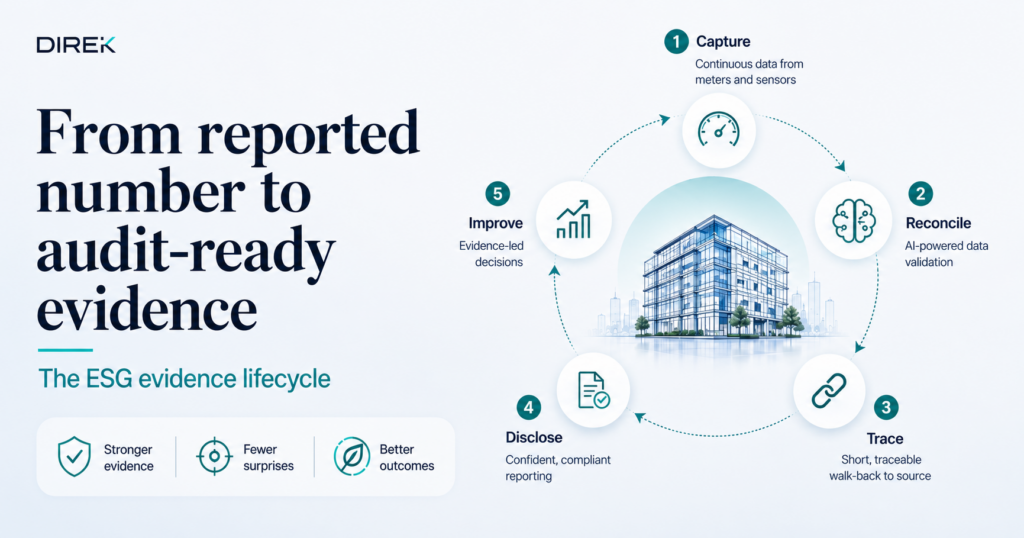
DIREK works with FM and ESG teams across UK estates, and the same pattern keeps surfacing. Reports do not fail because the wrong framework was chosen. They fail because the meter reads, refrigerant logs and occupancy hours behind the headline number cannot survive a second question from an auditor.
This post walks through what ESG reporting actually demands of a building, where the evidence usually breaks, and what to fix first.
What is ESG reporting, in plain terms
ESG reporting is the systematic recording and publication of how an asset performs on environmental, social and governance measures. In plain terms, it translates raw operational data into comparable metrics that investors, lenders, tenants and regulators can trust.
Environmental covers energy consumption, carbon emissions (Scope 1, 2 and 3), water use, waste volumes, refrigerant losses and indoor environmental quality. Social includes occupant wellbeing, accessibility and community impact. Governance covers board oversight, data integrity, ethical procurement and compliance records.
Frameworks such as the ISSB’s IFRS S1 and S2, GRESB, TCFD (now integrated into ISSB) and the UK’s Streamlined Energy and Carbon Reporting (SECR) set the required disclosures. None supply the evidence trail; that responsibility sits with your building systems.
Why ESG reporting matters for buildings
Buildings face tightening regulatory and market pressure. Under MEES regulations, properties must meet minimum EPC standards to be lettable. Large companies already report under SECR. From early 2026 the UK Sustainability Reporting Standards (UK SRS), aligned with ISSB S1 and S2, become available on a voluntary basis and are expected to become mandatory for listed entities thereafter.
Investors price in transition risk. RICS guidance updated in 2026 requires valuers to reflect material ESG factors in reported values. Poor performance raises borrowing costs, lowers rental yields and shortens asset life. Conversely, buildings with verified low-carbon performance attract longer leases, lower finance rates and higher exit values.
The practical outcome is simple: credible ESG data protects asset value and reduces compliance cost.
ESG reporting in real estate
In commercial real estate the focus narrows to operational performance and embodied carbon. GRESB, the global benchmark used by over 150 institutional investors, scores portfolios on energy intensity, water efficiency, waste diversion and tenant engagement. UKGBC’s Net Zero Carbon Buildings Framework and the Better Buildings Partnership’s responsible-property-management tools translate these into practical estate-level actions.
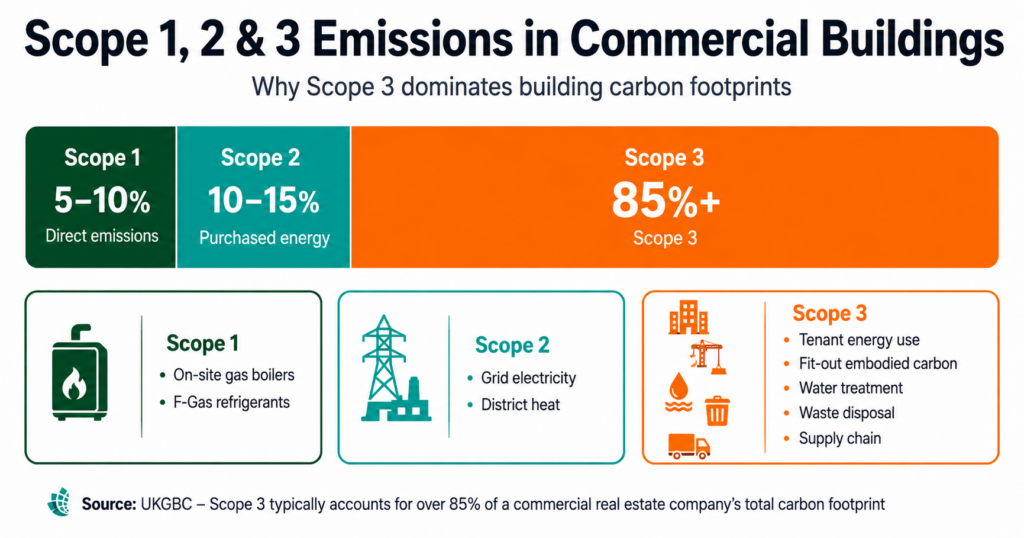
Asset managers must now report Scope 3 emissions that often represent 85 per cent or more of a building’s total footprint – primarily tenant energy use, fit-out materials and supply-chain waste. BRE’s BREEAM and WELL certifications add social and health metrics that feed directly into ESG scores.
The difference between voluntary and mandatory reporting has narrowed. Lenders reference these metrics in green-loan covenants; tenants demand them in green leases.
What building data is needed
Credible ESG reporting rests on six core data streams:
- Energy use: half-hourly or sub-metered electricity, gas and district heat consumption, split by landlord and tenant where possible.
- Carbon emissions: Scope 1 (on-site combustion and F-Gas refrigerant losses with leak-test records), Scope 2 (purchased electricity using location- and market-based factors), Scope 3 (tenant energy, embodied carbon in fit-outs, water supply and treatment, waste disposal).
- Water: metered consumption and discharge volumes.
- Waste: segregated volumes, recycling rates and landfill diversion, verified by waste contractor data.
- Occupancy and utilisation: hours of operation, desk or floor-plate utilisation to calculate intensity metrics per person or per square metre.
- Indoor air quality: continuous CO₂, temperature, humidity, PM2.5 and VOC readings that support occupant-wellbeing claims and WELL/Fitwel reporting.
Maintenance and compliance records – lift inspections, fire-system tests, asbestos registers – complete the governance picture.
Why the evidence usually breaks
The recurring gaps are familiar to any FM who has sat through an assurance review. Estimated consumption where meters exist. Sub-metering that covers only part of the estate. Refrigerant losses pieced together from supplier invoices rather than contemporaneous F-Gas logs. Tenant energy data chased once a year by spreadsheet. IAQ and occupancy claims supported by spot measurements instead of continuous sensor trails.
These are not framework problems; they are data-infrastructure problems. Assurance expectations tighten each year. UK SRS and GRESB both demand traceability back to source data. Without it, reported figures fail verification and expose the organisation to greenwashing risk.
Practical checklist for FM and ESG teams
Use this checklist to close the most common gaps:
- Map every utility meter and sub-meter to the correct asset and tenancy split.
- Confirm half-hourly data collection for all electricity supplies above 100 kW.
- Establish a monthly F-Gas leak-test schedule with digital logging and automatic upload to your reporting platform.
- Install or connect continuous IAQ sensors (CO₂, temperature, humidity, PM2.5, VOC) in occupied zones.
- Agree a data-sharing protocol with every tenant for their energy and waste figures, backed by lease clauses where possible.
- Assign a single data owner for each ESG metric with clear escalation routes.
- Run a quarterly walk-back test: pick one reported figure and trace it to the originating meter or sensor in under ten minutes.
- Store raw data with timestamps and audit logs for at least seven years.
How BMS, sensors and smart building data improve ESG evidence
Continuous, time-stamped data from a modern BMS or IoT sensor layer removes estimation and manual entry. Sub-meters feed granular consumption by floor or tenancy. Environmental sensors deliver minute-by-minute IAQ records that prove ventilation effectiveness and support health-based social claims. Occupancy sensors convert headcount estimates into verified utilisation data, sharpening carbon-intensity calculations.
DIREK’s D-XPERT agentic AI engine reconciles BMS feeds, sub-meter readings and sensor streams into a single verifiable record. The result is a short, traceable walk-back from any disclosed figure to its source. This approach satisfies ISSB, GRESB and UK SRS assurance requirements without rebuilding the estate.
UK ESG reporting position
In the UK, SECR remains the baseline mandatory requirement for qualifying large companies, covering energy use and Scope 1 and 2 emissions plus related efficiency actions. Listed entities already produce TCFD-aligned disclosures through the FCA. Early 2026 sees the publication of UK SRS S1 and S2, directly based on ISSB standards, initially voluntary but widely expected to become mandatory for listed and large private companies in subsequent years.
RICS valuation professionals must now consider material ESG factors in Red Book valuations. The Climate Change Committee continues to press for faster decarbonisation of the built environment, with performance-based energy ratings and higher EPC thresholds on the horizon. Real-estate portfolios that treat ESG reporting as a data-quality exercise rather than a compliance tick-box gain measurable advantage.
Practical next steps
Pick one reported metric this quarter – Scope 2 electricity for a single asset works well. Walk it back to the meter that produced it. Note every point where you had to estimate, interpolate or trust a tenant submission. That exercise is your evidence map.
Repeat for refrigerant losses, water consumption and one IAQ claim. The pattern of gaps tells you exactly where to invest first. If your estate lacks a sub-metering strategy or an owner for end-to-end disclosure, add sensors alone will simply generate more unaudited data. Fix ownership before you expand hardware.
How DIREK helps FM and ESG teams close the evidence gap
For FM and ESG teams that want to move from annual spreadsheet chasing to continuous, audit-ready evidence, DIREK’s ESG solution connects building systems, meters, sensors and operational data into one clear evidence layer. D-XPERT helps turn energy, carbon, IAQ and occupancy data into traceable ESG evidence packs, with sources, assumptions, exclusions, actions and ROI clearly documented. Instead of waiting until year-end to discover missing data, teams can identify evidence gaps earlier, prioritise what to fix, and give auditors, investors and clients a cleaner route from every reported number back to the building data behind it. Explore DIREK’s ESG Evidence & Reporting Platform here: https://direk.io/esg
Conclusion
What is ESG reporting? It is the disciplined translation of building operations into verifiable numbers that stakeholders can trust. In UK real estate that trust now determines lettability, valuation and access to capital. Start with the data you already own, close the obvious gaps, and build continuous evidence trails. The buildings that treat ESG as a data-quality discipline rather than a reporting burden will be the ones that remain competitive through the 2030s.
The honest caveats
Better data does not write the report for you, and it will not rescue a portfolio that has no governance behind its numbers. If your estate has no sub-metering strategy and no one owning the disclosure end to end, more sensors will only produce more unaudited data. Fix the ownership first.
Pick one disclosed number this week and walk it back to the meter or sensor that produced it. How long does the walk-back take, and how many people did you have to call?
If that walk-back is longer than it should be, see how we close the gap at direk.io/resources/get-a-demo.