CPD-Certified Training Now Available: AI in Facilities Management
DIREK LTD is pleased to announce that our CPD-certified one-day training programme, AI in Facilities Management, is now available to book.
Following the successful delivery of our first cohort on 27 January 2026 (hosted by Wates Group with academic contribution from UCL), we are now opening the programme to new organisations and upcoming cohorts. The first session confirmed what many FM leaders already feel: there is a huge opportunity in AI, but the value only becomes real when teams have the right foundations, shared language, and a practical method to assess what is safe, measurable, and worth implementing.
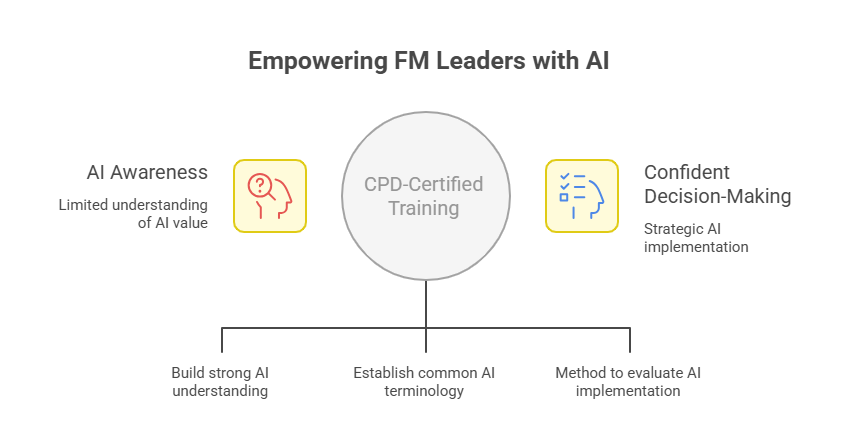
This training is designed for Facilities Management leaders, Heads of Innovation, Sustainability Directors, and operational teams who want to move from “AI awareness” to confident decision-making. It supports organisations that are dealing with everyday pressures, such as energy performance, occupant experience, compliance, asset reliability, service quality, and cost control, and who want to use data and AI to improve outcomes without increasing risk.
A one-day programme built on principles and practice
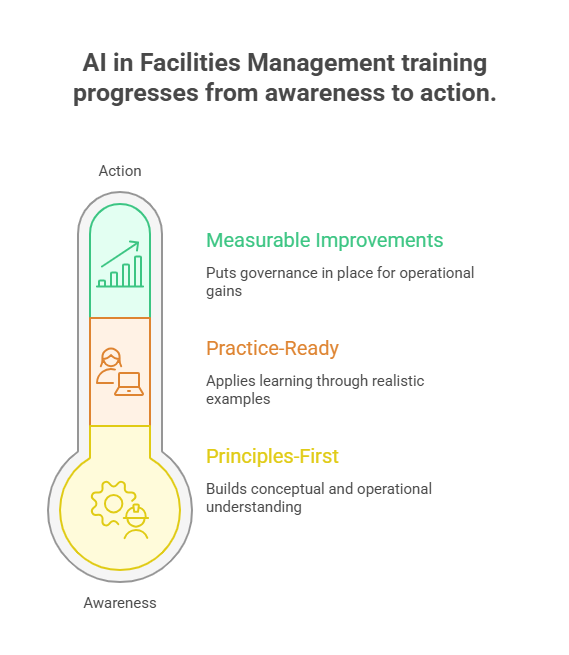
The course is structured to be principles-first and practice-ready. That means the day begins by building the conceptual and operational foundation required to work effectively with AI in facilities contexts. Only once that foundation is in place do we move into applied learning, where attendees work through realistic examples and structured decision-making exercises.
This approach ensures that the training remains valuable regardless of what tools or platforms an organisation uses. The goal is to equip participants with the knowledge and confidence to identify building issues, ask the right questions, and evaluate AI options in a responsible and commercially grounded way.
What the training covers
Across the day, the session covers the core themes FM and sustainability teams need to adopt AI safely and effectively:
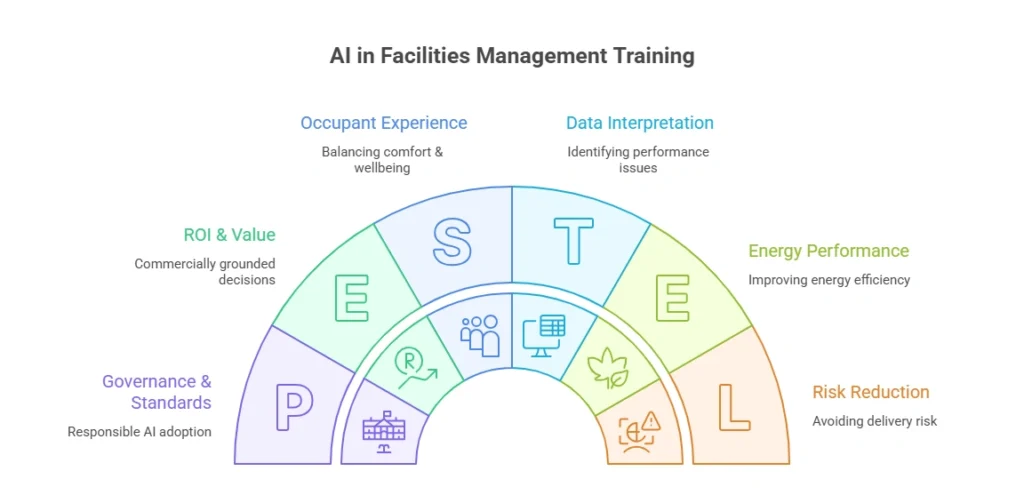
Occupant-centric building management
We explore what occupant-centric really means in practice, and how modern FM strategies balance comfort, wellbeing, productivity, and utilisation alongside energy efficiency and compliance. Participants learn how to interpret performance through the lens of people, not just systems, and how this changes what “good performance” looks like.
Best practices and industry standards
AI in FM must sit within strong governance, accountability, and assurance. We cover best-practice principles for responsible adoption, including how to think about oversight, repeatability, and operational ownership. The focus is on avoiding “black box” decisions and ensuring outputs can be trusted, explained, and acted upon.
Identifying performance issues from data
A major part of the course focuses on how to interpret building data to spot real issues. Participants learn how to recognise patterns and anomalies, differentiate short-term noise from persistent problems, and build an evidence-led understanding of what is happening and why. This includes practical ways to move from observation to diagnosis, and from diagnosis to action.
Understanding the types of problems that arise and how to respond
Buildings fail in predictable ways, but the symptoms can look similar even when the causes are different. The training provides a structured view of common issue types, including operational, behavioural, controls-related, and maintenance-driven problems. Attendees learn how to prioritise issues, evaluate impact, and follow appropriate resolution pathways, including what data is needed to confirm root causes.
Applied practice through realistic scenarios
The course concludes with applied learning using realistic FM scenarios. Participants work through guided exercises that bring the earlier foundations to life: evaluating AI opportunities, understanding limitations, assessing readiness, and shaping actions that can be implemented and measured. The emphasis is on practical judgement, not theory for its own sake.
What participants gain
By the end of the day, attendees leave with:
A clear framework to identify and prioritise AI opportunities in FM based on value, feasibility, and risk
Practical methods to interpret building data, detect issues early, and distinguish symptoms from root causes
A grounded approach to building ROI cases and defining success metrics that hold up with stakeholders
Confidence to put governance in place, reduce delivery risk, and move from pilots to measurable operational improvements
A shared understanding across FM, innovation, and sustainability teams, helping accelerate adoption and improve collaboration
The programme carries official endorsement from ASHRAE UK and CIB, reinforcing its relevance and quality for FM professionals.
Book your cohort
If you would like to run this training for your organisation or join an upcoming cohort, email [email protected].
Spaces are limited to keep the session interactive, hands-on, and high-impact.