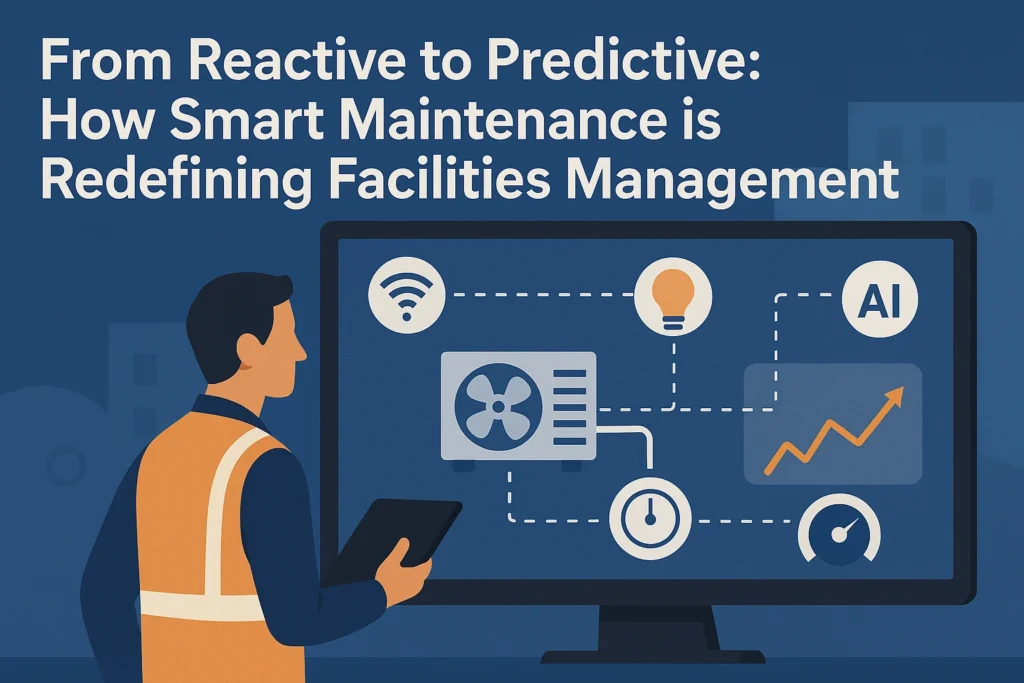
From Reactive to Predictive: How Smart Maintenance is Redefining Facilities Management
Smart maintenance combines IoT sensors, analytics, and AI into a single view, enabling facility teams to identify issues early, plan work efficiently, and boost performance without guesswork.
For years, facility teams have relied on scheduled inspections and manual reporting to maintain their assets. In today’s connected buildings, that approach is no longer enough. Equipment failures do not wait for calendar dates, and missed warning signs can lead to costly breakdowns, energy waste, and downtime.
This is why more organisations are shifting from reactive or time‑based maintenance to predictive operations. It is a smarter, data‑driven way to manage facilities that uses sensors and AI to detect early signs of faults before they become failures.
The Problem with Traditional Maintenance
Conventional maintenance models usually fall into two categories:
- Reactive maintenance: Fixing things only after they break.
- Preventive maintenance: Performing maintenance on a fixed schedule, whether needed or not.
Both approaches are inefficient. Reactive maintenance leads to unplanned downtime and expensive emergency repairs, while preventive maintenance can waste resources on unnecessary work. In both cases, teams are often working without real visibility into the actual condition of their systems.
What Makes Maintenance “Smart”?
Smart maintenance brings together IoT, analytics, and AI in a unified smart building management approach. Rather than time intervals, maintenance decisions are based on real‑time equipment data such as temperature trends, vibration levels, pressure, flow rates, and energy use gathered from connected systems across the building.
That data is analysed to detect early signs of wear, inefficiency, or potential faults. When a sensor picks up an anomaly, the system can automatically flag it for inspection, generate a maintenance request, or adjust performance settings to prevent a breakdown.
Why it matters:
- Extend asset lifespan
- Lower energy consumption
- Reduce labour and maintenance costs
- Increase reliability and safety
AI and Predictive Analytics in Action
Consider an HVAC system equipped with connected sensors. Over time, an AI building management system learns the normal behaviour of the plant, including how temperature, vibration, and airflow change under typical loads. When the fan motor begins drawing more power than usual or airflow starts to fluctuate, the AI detects the deviation and alerts the team long before a failure occurs.
This predictive insight lets maintenance be planned, not reactive. Instead of emergency callouts and downtime, facility teams can schedule quick, efficient interventions. The result is smoother operations, fewer disruptions, and measurable cost savings.
How DIREK Enables Predictive Facilities Management
At DIREK, predictive maintenance is a key part of an intelligent energy efficiency management solution. Our approach integrates IoT‑enabled sensors, analytics, and visual dashboards to give facility teams full visibility of equipment health and building performance in real time.
- Monitor HVAC, lighting, and electrical systems continuously
- Receive instant alerts for abnormal readings or energy spikes
- Prioritise tasks based on actual equipment condition
- Align condition‑based monitoring with sustainability goals
For organisations using DIREK’s D‑XPERT® platform, predictive analytics can be viewed alongside occupancy, energy, and environmental insights, which makes it easier to manage comfort, cost, and carbon in one place.
The Benefits at Scale
Across large estates, predictive maintenance transforms facilities management from a reactive service into a strategic performance driver.
- Up to 30% lower maintenance costs by avoiding unnecessary servicing
- 40% reduction in downtime through early fault detection
- 10–20% energy savings from optimised system performance
Beyond cost savings, predictive operations help facility managers move from firefighting to forward planning. Teams gain time to focus on long‑term improvements such as reducing carbon footprint, increasing occupant comfort, and supporting ESG reporting.
A Smarter Future for Facilities Management
The future of FM lies in connected intelligence. As IoT and AI technologies become more accessible, even smaller organisations can adopt predictive maintenance and benefit from reduced costs, improved energy performance, and longer asset lifecycles.
Smart maintenance is about empowering teams with insight. For facility managers, it means moving from maintaining assets to maximising their value and shaping the future of sustainable building operations.

Why Estates and FM Teams Now Own ESG Credibility
Estates and FM teams now own ESG credibility because auditors
Why ESG Disclosure Is Quietly Becoming a Machine-Readable Asset Class
ESG disclosures are turning into machine-readable data, scored at scale.

Scope 3 in real estate: where carbon reports break
Scope 3 emissions reporting is where most real estate carbon